Race Consciousness by Judith Jackson Fossett
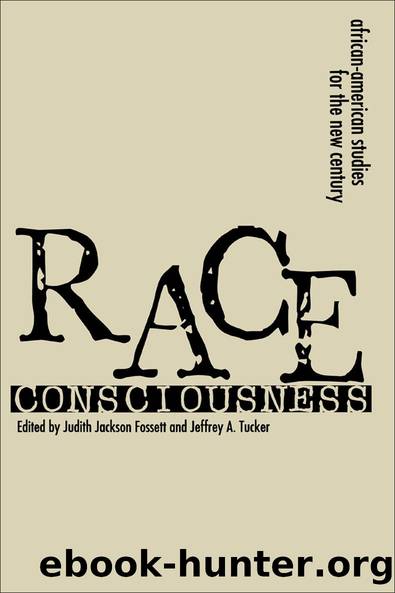
Author:Judith Jackson Fossett [Fossett, Judith Jackson]
Language: eng
Format: epub
Tags: Social Science, Ethnic Studies, American, African American & Black Studies
ISBN: 9780814728918
Google: F8_6hr-fy00C
Publisher: NYU Press
Published: 1997-01-01T02:53:12+00:00
But the 1840s marked the beginnings of a decisive shift in the political language of African Americans. The discordant waves of Jacksonian democracy that had already made their way into black enclaves in the North joined with the new science of race.50 Environmental and biblical accounts of racial differences were now under constant attack. As a result of the seemingly concrete findings of phrenology and ethnology, African Americans were seen as intrinsically different and, for some, inherently lacking in certain moral and mental capacities. Although African Americans responded to these findings with their own ethnological and biblical accounts,51 many assumed the validity of a portion of the claim: race has intrinsic value.
The different ways the language of race was embraced affected the use of the word ânation.â The idea of nation among African Americans in the early nineteenth century was mainly rhetorical.52 The word was not used to indicate something that actually existed in the world, a sort of nonmoral, descriptive statement about a thing that could either be true or false. Instead, nation language was a means of grounding a set of common experiences and relationships in an effort to combat American racism. And the broader cultural pattern of Exodus symbology in the United States provided the vocabulary for understanding and negotiating Americaâs racial hegemonic order. The idea of a black nation, then, was achieved by dramatic reenactment of the deliverance of the nation of Israel and, subsequently, a kind of inversion of Americaâs imagined communityâthe New Israel contained the Old.
African Americansâ rhetorical use of nation in the early nineteenth century was ambiguous or âfuzzy.â âIt did not claim to represent or exhaust all the layers of selfhood of its members . . . [nor] . . . did [it] require its members to ask how many of them were in the world.â53 The concept was used only for âpractical purposes of social interaction.â54 Remember that race, during this period, has no intrinsic value; it is only a name for environmental effects and a means for mobilizing persons (with a variety of allegiances) to struggle against American racism.
However, the concept of nation in mid-nineteenth-century black America was rhetorical and nonrhetorical. Early conceptions of the national communityâideas generated through the reading and ritualization of the story of Exodusâstood alongside nonrhetorical accounts of nationality and the new racial science. Indeed, nation was defined in terms of genealogy and geography. No longer was the term simply used to ground a set of common experiences and relationships in an understanding of Americaâs racial order. Instead, race and nation joined to signal an objective entity, that which, if it did not already exist, should exist in the world.
But the use of the Exodus story among African Americans survived the pull of racial science, perhaps because the metaphors of the story lent themselves to a wide range of analyses and uses. Political arguments that used rhetorical forms such as the Jeremiad and Ethiopianism were possible to carry on inside the structures of Exodus:
Within the frame
Download
This site does not store any files on its server. We only index and link to content provided by other sites. Please contact the content providers to delete copyright contents if any and email us, we'll remove relevant links or contents immediately.
| Anthropology | Archaeology |
| Philosophy | Politics & Government |
| Social Sciences | Sociology |
| Women's Studies |
Cecilia; Or, Memoirs of an Heiress — Volume 1 by Fanny Burney(32636)
The Great Music City by Andrea Baker(32609)
Cecilia; Or, Memoirs of an Heiress — Volume 2 by Fanny Burney(32010)
Cecilia; Or, Memoirs of an Heiress — Volume 3 by Fanny Burney(31996)
We're Going to Need More Wine by Gabrielle Union(19108)
All the Missing Girls by Megan Miranda(16314)
Pimp by Iceberg Slim(14664)
For the Love of Europe by Rick Steves(14574)
Bombshells: Glamour Girls of a Lifetime by Sullivan Steve(14136)
Norse Mythology by Gaiman Neil(13457)
Talking to Strangers by Malcolm Gladwell(13439)
Fifty Shades Freed by E L James(13289)
Mindhunter: Inside the FBI's Elite Serial Crime Unit by John E. Douglas & Mark Olshaker(9420)
Crazy Rich Asians by Kevin Kwan(9345)
The Lost Art of Listening by Michael P. Nichols(7547)
Enlightenment Now: The Case for Reason, Science, Humanism, and Progress by Steven Pinker(7354)
The Four Agreements by Don Miguel Ruiz(6835)
Bad Blood by John Carreyrou(6671)
Weapons of Math Destruction by Cathy O'Neil(6362)
